 Login
Login11 Nov 2025
What is a game model in football and why do principles of play matter?
You must adapt to the players you have, but fundamentals (principles) stay the same.
— Pep Guardiola
Modern football is more complex, faster, and more tactically demanding than ever. In this environment, coaches need more than isolated tactics or match-specific plans — they need a clear identity that guides every action on the pitch. This identity is what we call a game model.
A game model is the framework that defines how a team plays in all moments of the game. It acts as the team’s tactical DNA: the concepts, behaviours, and principles that remain consistent regardless of opponent, formation, or lineup. While formations can change and personnel may vary, the core ideas — how the team attacks, defends, and transitions — stay stable.
A strong game model provides clarity. Instead of players guessing what to do in certain situations, they understand the expected behaviours. This reduces uncertainty, increases synchronisation, and allows players to make faster, better decisions under pressure. The best teams in the world — from Guardiola’s Manchester City to Klopp’s Liverpool and Xabi Alonso’s Leverkusen — operate through a set of non-negotiable principles that define the way they interpret the game.
The importance of the Principles of Play
The principles of play are the actionable concepts that make a game model work. They are not rigid instructions but adaptable reference points that guide player behaviour. These principles exist across all phases of the game:
- Attacking principles
These govern how a team creates superiority, manipulates the opponent, and progresses the ball. Ideas such as creating width, offering depth, circulating the ball, occupying spaces between the lines, or penetrating with purpose ensure that attacking actions are coordinated rather than improvised. - Defensive principles
A team’s ability to defend well relies on collective organisation — pressing as a unit, protecting central areas, controlling the space behind the defensive line, and forming a compact structure. These principles help teams limit the opponent’s options and regain the ball efficiently. - Transitional principles
Transitions often decide games. Effective teams know exactly how to react the moment possession is won or lost. Whether it’s counter-pressing instantly, securing the first pass, stretching the pitch, or exploiting overloads, transitional principles give structure to chaotic moments.
Together, these principles create a consistent framework that players can rely on. They empower decision-making, ensure cohesion between units, and create a shared understanding that reduces the need for constant micro-instructions. Most importantly, principles allow coaches to adapt their style to different players while staying true to their football identity — exactly as Guardiola suggests.
How Finalthird helps coaches build their Game Model
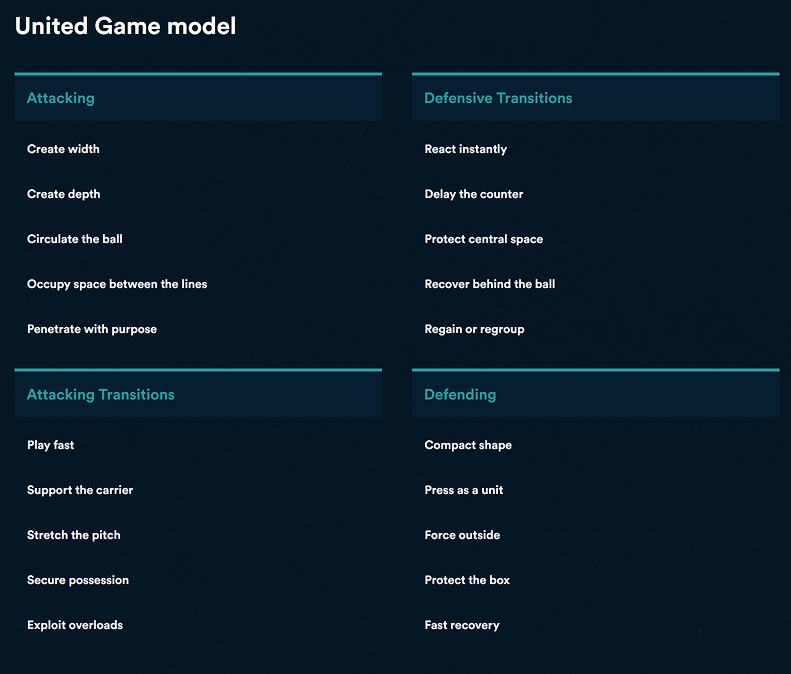
Finalthird makes building a clear, organised game model simple and intuitive. The Game Model feature allows coaches to define key principles for each phase of the game — Attacking, Defensive Transitions, Attacking Transitions, and Defending — exactly like the structured layout shown in the game model screen.
Coaches can outline the behaviours they expect from their team: how to create width, how to react instantly upon losing the ball, how to protect central spaces, or how to press as a unit. These principles become a living reference point that guides the entire coaching process. Because the game model in Finalthird is integrated into the broader app ecosystem, it connects directly with session planning, team analysis, and player development. This allows coaches to align training sessions with their model, reinforce principles consistently, and ensure that players understand the expectations in every moment of the game.
With Finalthird, the game model becomes more than an idea — it becomes a clear, structured, and actionable blueprint for how your team plays.
.svg)


.svg)