 Login
Login11 Nov 2025
Goal setting in football

The trouble with not having a goal is that you can spend your life running up and down the field and never score
Bill Copeland
Goal setting is an essential skill in every walk of life, but in football it becomes a fundamental driver of development, motivation, and long-term improvement. If players truly want to stretch their potential to its limits, they must set targets that provide direction, maintain focus, and inform daily behaviours. Clear goals maximise commitment, elevate the quality of each training session, and help players understand the purpose behind their actions.
Three key types of goals:
- Outcome goals (The Why) – These give players the bigger purpose: winning leagues, earning selection, becoming the best version of themselves.
Example: Become the top scorer in the league. - Performance goals (The What) – These indicate the standards required to achieve the outcome.
Example: Maintain a 70% shots-on-target rate in league matches. - Process goals (The How) – These detail the actions, habits, and training priorities that drive daily progress.
Example: Improve finishing technique, scan earlier before receiving, or develop explosive speed during pre-season.
The effectiveness of goals depends heavily on their quality. Poorly designed goals demotivate players, while well-structured goals accelerate development. To be effective, goals must be:
- Motivational – ambitious enough to inspire growth.
- Realistic – attainable, preventing discouragement.
- Measurable – clearly trackable, so progress can be evaluated.
- Time-bound – with short, medium, and long-term deadlines.
- Specific – vague goals achieve vague outcomes; clarity creates direction.
- Controllable – focused on actions a player can directly influence.
- Accountable – shared with someone (coach, psychologist, mentor) who helps reinforce commitment.
A valuable part of the process is self-evaluation, where players and coaches (or sports psychologists) reflect on strengths and weaknesses, identifying which areas require improvement. Goals can be split into mental, tactical, technical, and physical categories, giving players a holistic development structure. Once goals are set, the real challenge begins: maintaining discipline, resilience, and perseverance. This daily commitment separates players who talk about improvement from those who truly achieve it.
Reviewing goals is every bit as important as defining them. Regular reflection allows players to understand what worked, what didn’t, and what needs adjusting. Failure to meet a goal is not a setback — it’s feedback. Players must be willing to reassess, recalibrate, and continue forward. Improvement is rarely linear, but consistency in setting, following, and reviewing goals ensures long-term growth.
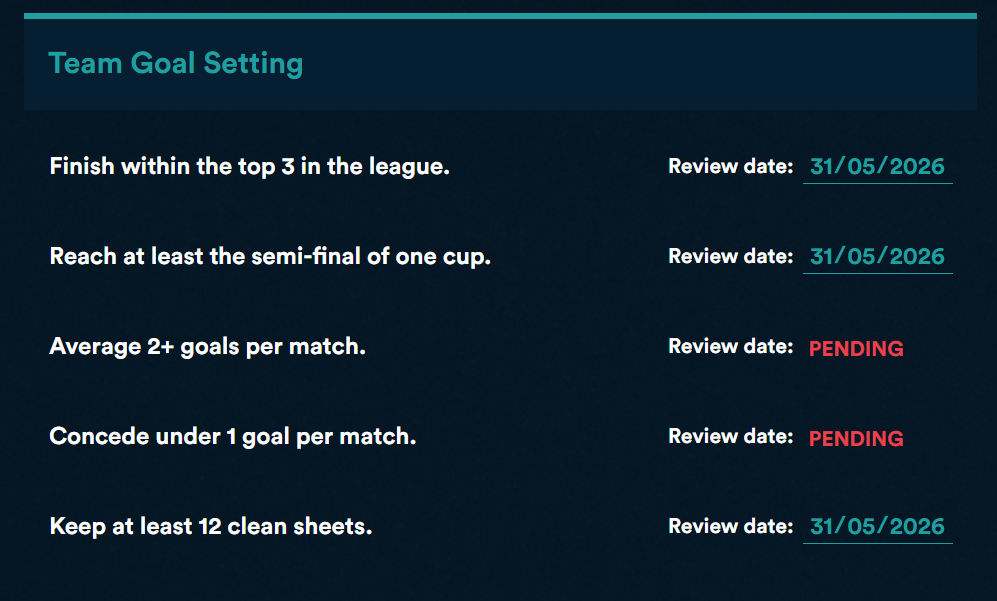
How Finalthird helps players and teams achieve their goals
Finalthird makes goal-setting practical, intelligent, and seamlessly integrated into the coaching workflow. Coaches can set both team goals (via the Dashboard) and individual player goals (within each Player Screen), ensuring alignment between collective ambitions and personalised development plans. Each goal can be assigned a review date, and once that date is reached, the goal automatically appears as pending, prompting timely reflection and adjustments — a crucial part of effective goal-setting.
What sets Finalthird apart is how deeply goals are connected to real performance data. The platform tracks all key match and training statistics, evaluates team performance across every phase of play, and assesses each player’s attributes in the technical, tactical, physical, and mental domains. This gives coaches a clear, objective picture of where the team and its players are excelling — and where improvement is needed.
By combining goal-setting tools with detailed performance insights, Finalthird enables coaches to identify priority development areas, assign targeted goals, and monitor progress with precision. The result is a continuous feedback cycle where goals are not just written down, but actively informed by data, regularly reviewed, and meaningfully connected to training content. Finalthird transforms goal-setting from theory into a structured, measurable, and highly effective part of a team’s long-term development strategy.
.svg)


.svg)