 Login
Login11 Nov 2025
The importance of planning the weekly training process in football
Elite performance in football is never accidental — it is the outcome of deliberate planning, structured workloads, and a training process that prepares players physically, tactically, technically, and mentally for the demands of the match. The weekly training plan, often called the microcycle, is the backbone of a team’s development. It gives structure to the week, ensures players recover properly, and guarantees that tactical concepts are layered in a logical, progressive way.
At the highest level, planning the weekly process allows coaches to control training intensity, develop game-specific behaviours, prevent fatigue, and ensure the team arrives at match day with clarity and sharpness. Without a clear plan, sessions become random; with a plan, every exercise, meeting, and tactical rehearsal has purpose.
How elite clubs plan their weekly training process
Most elite clubs follow variations of tactical periodisation, a methodology that structures the week around the tactical needs of the team. Rather than separating physical, technical, and tactical work, everything is integrated into the tactical idea of how the team plays.
Here are common principles in elite clubs:
1. Day After the Match — Recovery
- Light rondos, mobility, and regeneration work.
- Separation between starters and substitutes (starters recover, non-starters train).
- Tactical content is minimal or classroom-based.
2. Two Days After the Match — Progressive Loading
This is where training “begins” again.
- Moderate intensity.
- Tactical focus on the global structure:
- Defensive organisation,
- Team compactness,
- Pressing structures,
- Out of possession principles.
- Physical load increases but without maximal intensity.
3. Midweek — The Hardest Day
This is known as the MD-3 peak day (Match Day minus 3).
- Highest physical and tactical load of the week.
- Focus on transitions (very physically demanding), counter-attacks, high pressing, recovery runs, and medium-to-big positional games.
- This day conditions the team’s ability to reproduce match demands.
4. Two Days Before the Match — Game Situations & Attacking Patterns
- Medium intensity.
- Tactical detail becomes more specific to how the team wants to attack:
- Final third combinations,
- Build-up patterns,
- Movements between the lines,
- Pressing triggers.
- Set-pieces may be introduced here.
5. One Day Before the Match — Tactical Clarity
- Light, sharp session with low physical demand.
- Focus on speed of decision-making, finishing, set pieces, and final details.
- Aim: clarity, confidence, and freshness — not fatigue.
6. Match Day — Execution
- Behaviour in every phase of play reflects what the team rehearsed throughout the week.
This structured rhythm allows players to anticipate what each day demands, helping them stay mentally prepared and physically aligned with the seasonal plan.
Tactical Periodisation & Barcelona’s Integrated Training
Tactical periodisation, originally shaped by Vítor Frade and embraced by elite coaches such as Mourinho, Guardiola, and Xavi, is built on the idea that players learn football by playing football — in realistic situations that replicate the game’s demands.
At FC Barcelona, training follows the integrated training model, heavily influenced by Johan Cruyff and Seirul·lo’s methodology. Instead of isolating fitness, technique, or tactics, everything is trained together through positional games, rondos, and game-realistic drills.
Key concepts include:
- Game Intelligence first – every exercise teaches decision-making.
- Positional superiority – understanding where to be to help the team.
- Interconnection – technical, physical, tactical and mental components trained simultaneously.
- Small-sided games – to overload cognitive and tactical speed.
- Positional rondos & posicionales – creating automatisms for build-up, progression, and chance creation.
Barcelona’s method respects player wellbeing, progressively increases load, and ensures the team is always training in line with its game model — not random drills.
What Tactical Aspects Should Be Trained During the Week?
Different phases of the game naturally align with different days of the microcycle:
- Transitions (both attacking & defensive) — MD-3 (highest load day).
- High pressing, counter-pressing, defensive organisation — early-to-midweek.
- Attacking patterns, build-up coordination, final third combinations — MD-2 and MD-1.
- Opponent analysis & specific game plan — MD-1 and matchday preparation.
- Recovery, regeneration & psychological reset — post-match and early week.
When the weekly plan is aligned with tactical principles, players build consistency, confidence, and a shared understanding of how the team should perform.
How Finalthird supports the weekly planning of the training process
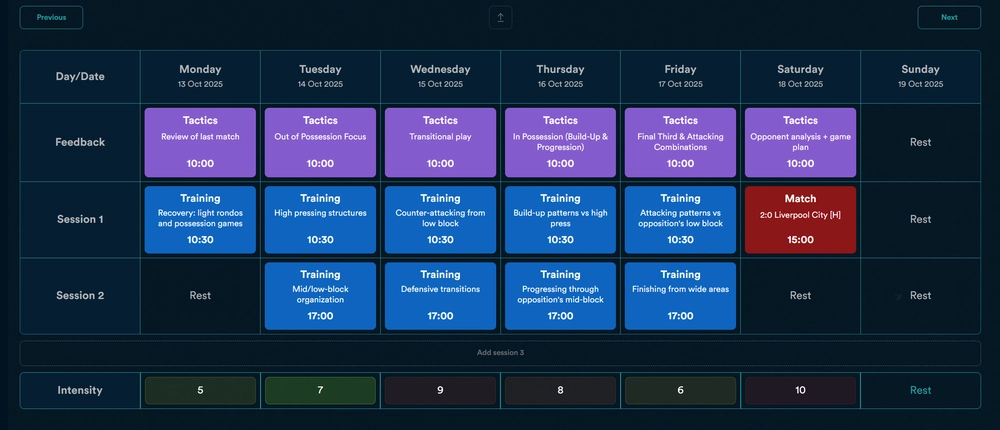
The Weekly Planner tool in Finalthird gives coaches a powerful, structured way to design a professional microcycle with the same clarity and logic used in elite clubs. Coaches can add different event types — Tactics, Training, or Match — and customise each event with a specific title such as “Build-up vs High Press”, “Defensive Transitions”, or “Opponent Analysis & Game Plan”. Each event can also include attached files (session plans, tactical presentations, video outlines), allowing coaches to present or brief the team directly from the planner itself. This keeps the entire week organised, visual, and easily accessible.
Coaches can also assign an intensity level to every day, helping them follow tactical periodisation principles: recovery early in the week, peak load in the middle, and refreshed sharpness before the match. This creates a microcycle structure that matches the physical and tactical demands of the game.
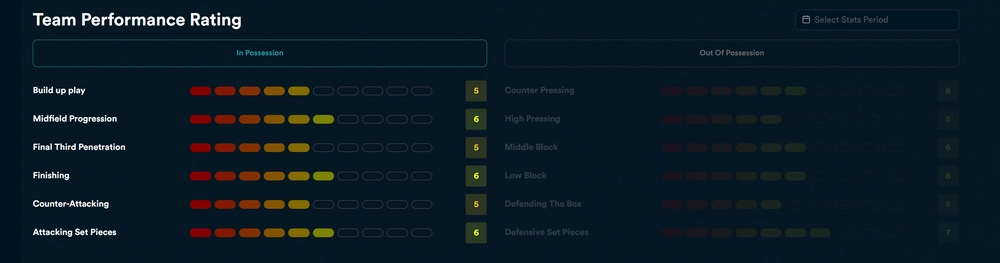
Crucially, the Team Performance Evaluation tool — which rates performance in each phase of play (e.g., build-up, mid-block, counter-pressing, final third penetration, defending the box) — directly informs the weekly plan. By showing coaches exactly which areas of the game are underperforming, Finalthird helps them identify the priorities for the upcoming week. Whether the data shows issues in finishing, high pressing, counter-attacking, or defending set pieces, these insights feed straight into the planner so coaches can allocate focused sessions to the areas needing the most improvement. This creates a fully integrated cycle where performance analysis drives planning, planning drives training, and training drives development — all within one platform.
.svg)


.svg)